




Eco-Museums as response to climate change, democracy pressure and social inclusion
The PLACE project is working on preserving local traditions to tackle today’s global challenges
The PLACE project Team was in the Nordhordland district (Norway) hosted by the STIFTINGA MUSEUMSSENTERET I HORDALAND (MUHO) and the Heathland Centre to understand why Bio Cultural Heritage is important to local communities and how can Eco-Museums, as custodian of knowledge, have a role to fight against today’s World biggest challenges and to improve environmental and social conditions.
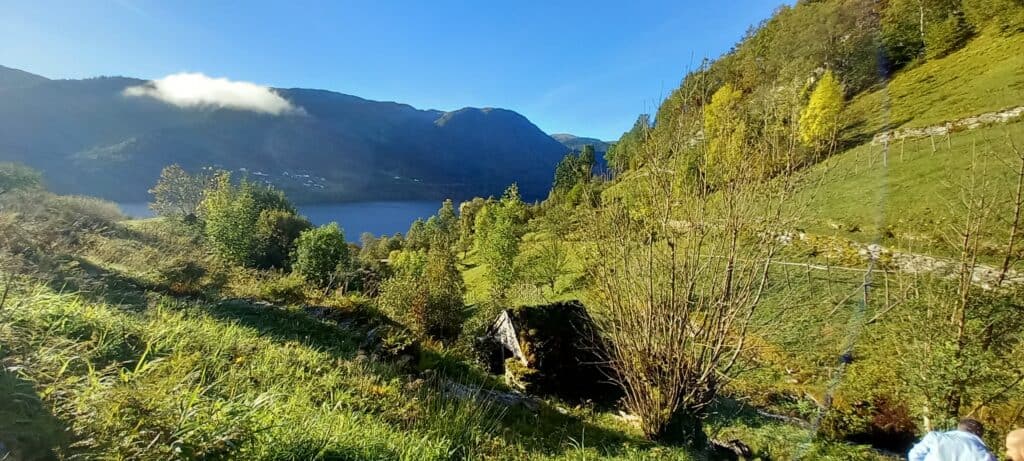
The Nordhordland district in the western part of Norway, part of the Nordhordland UNESCO Biosphere Reserve, is located just north of the city of Bergen in Vestland county. Throughout its journey the Team visited the Havrå farm, the Osterøy Museum, the Heathland Center at Lygra and the Hillesvåg Ullvarefabrikk Woollen Mill. Here, the PLACE Team has the opportunity to meet many local farmers, entrepreneurs, craftsman and craftswoman who work to keep alive local traditions, practices and techniques developing their own farming tools, harvesting the oats, working out the grain with traditional mills, farming local breeds and producing local eno-gastronomic products.
The local community understands that the value of bio cultural heritage is endangered by demographic shifts, globalization, and economic pressures and work to preserve techniques and practices of the past and to transfer this knowledge to younger generations.
In Europe, by bio cultural heritage we mean traditional farming practices, land stewardship systems, and local craftsmanship of rural areas, very important for the sustainability of rural communities, as it reflects the deep interdependence between cultural traditions and ecosystems (1). Unfortunately, traditional knowledge, cultural landscapes, and local biodiversity in rural areas are in rapid decline due to depopulation, modernization, and agricultural intensification (2).
While there is no official EU definition of “ecomuseum,” the concept is widely understood within European cultural and heritage policy frameworks as a flexible, community-based model that integrates cultural, natural, and intangible heritage in a specific territory. In the context of the PLACE project, the term “ecomuseum” is used inclusively to refer to a range of participatory and landscape-embedded heritage institutions, including living museums, open-air museums, and territorial museums. These models share a commitment to community engagement, sustainability, and the valorization of BCH: ecomuseums, by their very nature, are deeply embedded in local communities and landscapes, serving as community-driven institutions that preserve, interpret, and activate cultural and natural heritage (3).
Social inclusion:
Bio-cultural heritage strengthens inclusion because traditional practices are often based on shared knowledge, collective work and intergenerational transmission. They create opportunities for older people, young people, farmers, craftspeople and marginalised rural communities to participate in local economic and cultural life. Traditional skills can also provide accessible forms of employment and entrepreneurship, particularly in areas affected by depopulation. When combined with tourism, education or contemporary design, local crafts and food traditions can generate new income while reinforcing community identity.
Climate change:
Many traditional land-management practices developed through centuries of adaptation to local climate, soils, water availability and ecosystems. They can therefore complement modern technologies in climate adaptation and biodiversity conservation.
Traditional crop varieties can increase agricultural diversity and resilience to drought, while practices such as terracing, agroforestry, rotational grazing and traditional water-management systems can reduce erosion, retain water and help prevent wildfires. Maintaining local craftsmanship also encourages the use and repair of locally available materials, supporting more circular and resource-efficient economies.
An interesting example of cultural and ecological tradition actively preserved is that of rotational prescribed burning of coastal heathlands at Lygra in Nordhordland. This practice foresees carefully timed, rotational prescribed burns to clear older, woody, and unpalatable heather. The coastal heathlands, characterized by rocky, nutrient-poor soil covered heavily by heather and low shrubs is turned fertile again by the fire which removes old biomass and returns a light layer of minerals to the thin soil, stimulating fresh, nutrient-rich green shoots to sprout. The rejuvenated heather becomes soft and nutritious enough for hardy traditional livestock—such as gammelnorsksau (old Norwegian sheep), which graze these outfields year-round.
At Lygra in Nordhordland, the Heathland Centre and the farmers actively preserves and showcases and demonstrates how humans have shaped and maintained this open landscape since the Neolithic/Stone Age. Indeed, this ancient technique is of vital importance for biodiversity too. In fact, controlled burning prevents overgrown monocultures and wildfire risks while creating a diverse mosaic of plant and animal habitats.
Pressure on democracy:
Bio-cultural heritage can contribute to democratic resilience because many rural traditions depend on collective decision-making and the shared management of common resources. Irrigation associations, communal forests, grazing commons and agricultural cooperatives require communities to negotiate rules, responsibilities and access to resources.
These practices strengthen social ties and create spaces where people actively participate in decisions affecting their territory. This is particularly relevant where rural depopulation, economic inequality, political polarisation or distrust in institutions weaken democratic participation. Recognising local knowledge can also help ensure that environmental and territorial policies are developed with communities rather than simply imposed on them.
(1) Maffi (2005) and Pretty et al. (2009)
(2) Pretty et al. (2009); Agnoletti & Rotherham (2015)
(3) Davis (2007)